Buying smart
Signals worth more than a star rating
Chinese marketplace storefronts do not always carry the kind of review history Western shoppers default to checking. A few other signals travel further.
Picking the right item starts before you ever paste a link into Tomebuy: judging a listing before you order is a seller-and-sizing problem first, and a Tomebuy problem only once the order already exists.
Shop age and catalogue depth
A storefront with a long catalogue and many listing dates spread across months is a steadier bet than a single-product shop that appeared recently, all else equal.
Specification consistency
Compare the title, the attribute table, and the option menu against each other. Sellers who keep those three consistent tend to keep the rest of the listing accurate too.
Photo originality
Studio photos lifted wholesale from a brand's own marketing are a weak signal either way, but a seller who also shows their own in-hand or packaging photos is giving you more to verify against your QC photos later.
Response in the listing's Q&A, where shown
A seller who has answered buyer questions about sizing or material directly on the listing has already done some of the verification work for you.
Dropdown sizes and the measurement table can tell different stories
Garment and footwear listings on Chinese marketplaces commonly use a size label (S/M/L, or a number) in the option menu that maps to a measurement chart lower on the page, and the two can tell a shopper two different stories on the same listing. A size chart printed only as part of a photo, rather than in the structured table, is also easy to miss on a quick scroll.
Measurements on Chinese listings are usually centimetres, and a garment's stated measurement is sometimes the flat-lay width (a shirt's chest measured pit to pit and doubled) rather than a circumference, which reads roughly half of what a Western size chart would show for the same garment. When a chart's numbers look unusually small for the labelled size, that is very often why.
Quantity and weight change how customs reads a parcel
From Tomebuy's own Distribution help article, read 2026-10-21.
Tomebuy's own guidance names two tripwires a customs officer watches for when deciding personal versus commercial: total weight past 10 kg, and a stack of the exact same item in one box. Buying several of one thing, a dozen of the same T-shirt for friends, say, is worth weighing against those two tripwires before you default to combining everything into the single biggest parcel; the handling-fee savings on the freight page only matter if the parcel clears customs smoothly in the first place.
A short list worth running through each time
- Read the option menu, not just the hero photo; confirm colour, size, and any bundled accessories match what you expect to receive.
- Check the attribute table against the title for material claims specifically; the two sometimes disagree.
- Note the minimum order quantity on 1688 listings before treating a low unit price as a single-item price.
- Decide your consolidation plan before items start arriving, since Tomebuy's storage clock starts the moment the first item is logged in, not when the last one shows up.
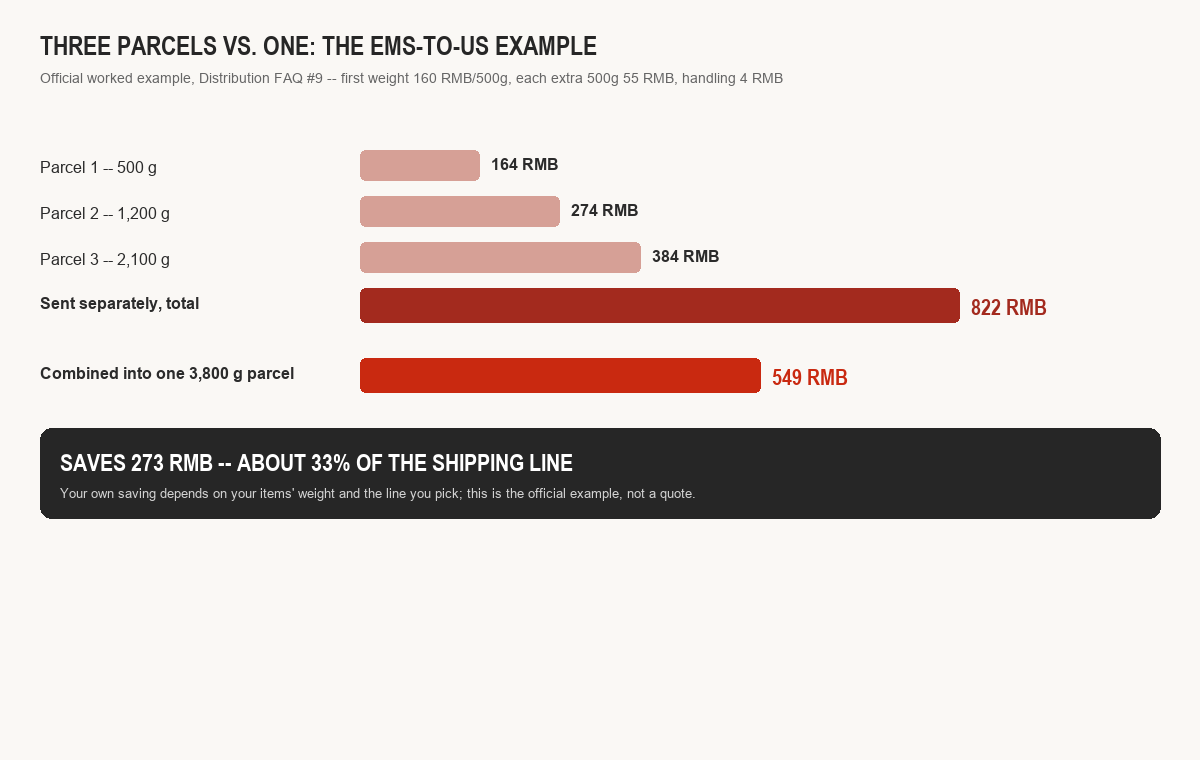
The same worked example as the manifest and freight pages
Common shorthand on Taobao, 1688 and Weidian listings
General marketplace literacy, not specific to Tomebuy.
| Term seen on a listing | What it usually means |
|---|---|
| Spot stock / ready stock | Ships immediately from existing inventory, as opposed to a pre-order with a wait. |
| Pre-order | Made or sourced after you order; expect a longer domestic lead time before the item even reaches the warehouse. |
| Domestic shipping included | The seller covers shipping to the warehouse within China, separate from the international leg Tomebuy arranges afterward. |
| Real / actual photos | The listing photos are of the actual item, not a studio or brand marketing shot; worth comparing against your QC photos once they arrive. |
| Wholesale lot | Sold in bulk with a minimum order quantity; check that figure before treating the listed unit price as a single-item price. |
| Flat-lay measurement | A garment measured laid flat and doubled, not a circumference; see the sizing note above. |