Choosing a catalogue site worth trusting
A catalogue site is a layer between you and the agent, not the agent itself
Sites like this one do not take your payment or ship your parcel; Tomebuy does. What a catalogue site is actually responsible for is accuracy: are the numbers it quotes current, sourced, and checkable against the agent's own pages.
What follows is a general approach to choosing a spreadsheet site, meaning any browsable product-catalogue guide for a shopping agent, this one included, not just advice specific to Tomebuy.
Including this one
Does it name its sources?
A specific policy page and a capture date beats a vague “Tomebuy says”. If a number has no source you can go check yourself, treat it as unverified.
Does it date its facts?
Fees, storage windows, and exchange rates change. A page with no date on its claims cannot tell you whether what you are reading is still true.
Does it admit contradictions, or paper over them?
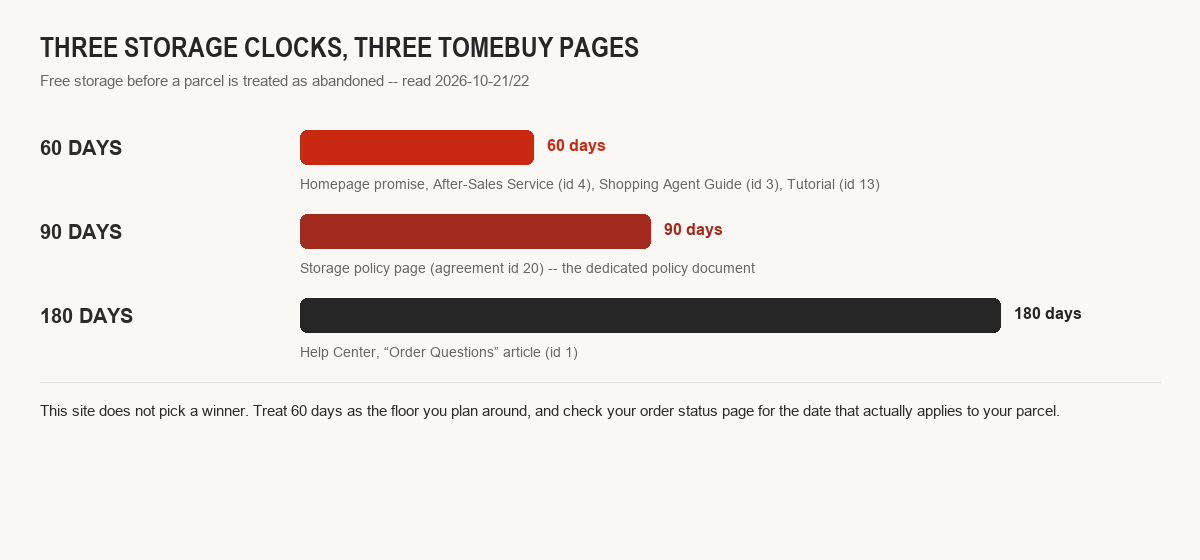
Agents' own pages disagree with themselves more often than you would expect, see the storage page for Tomebuy's own three-way mismatch. A catalogue site that quietly picks the flattering number is not doing its job.
Does it publish a real freight price it cannot stand behind?
Several agents, Tomebuy among them as covered on the freight page, do not publish reliable public rate data. A site that still prints a specific shipping price in that situation is guessing, not reporting.
Three practical signals
- An updates log with real dates and what changed, not just a copyright year in the footer.
- Outbound links that work. A catalogue site with a pile of dead links to the agent it covers has stopped being checked.
- Numbers that move when the agent's own numbers move. If an agent changes a storage window or a fee and the catalogue site never updates, it was a one-time snapshot, not a living resource.
Held to the same standard
Every figure on this site names the Tomebuy page it came from and the date it was read; the updates page tracks what has changed since. Where Tomebuy's own pages disagree, this site says so rather than choosing the more favourable number, as on the storage and QC photos pages. Where Tomebuy's own rate data is not publishable, this site says that too, rather than inventing a shipping price, as covered on the freight page.
Three pages, three storage periods, one footnote
Common patterns on weaker catalogue sites
- A single flattering number repeated on every page (a storage window, a fee rate) with no page-specific source, when the agent's own site actually gives more than one answer.
- Shipping prices printed as if they were quotes, when the agent itself has not published a working rate calculator.
- No visible operator name, contact address, or independence disclaimer, making it hard to tell whether you are reading the agent's own marketing or an outside review.
- Product photos presented as though they were the agent's own live inventory feed, with no note about where they actually came from.
Look for the disclaimer, then look for the gap it implies
A catalogue site that is genuinely independent will say so clearly, on every page, not buried once in a terms document. It will also behave like an outside party: linking to the agent's actual pages for anything transactional, rather than trying to collect your payment or account details itself. If a site is vague about who runs it while asking for payment or account information directly, that gap between the claim and the behaviour is the signal worth noticing, more than the disclaimer text itself.